

9 Jul 2024
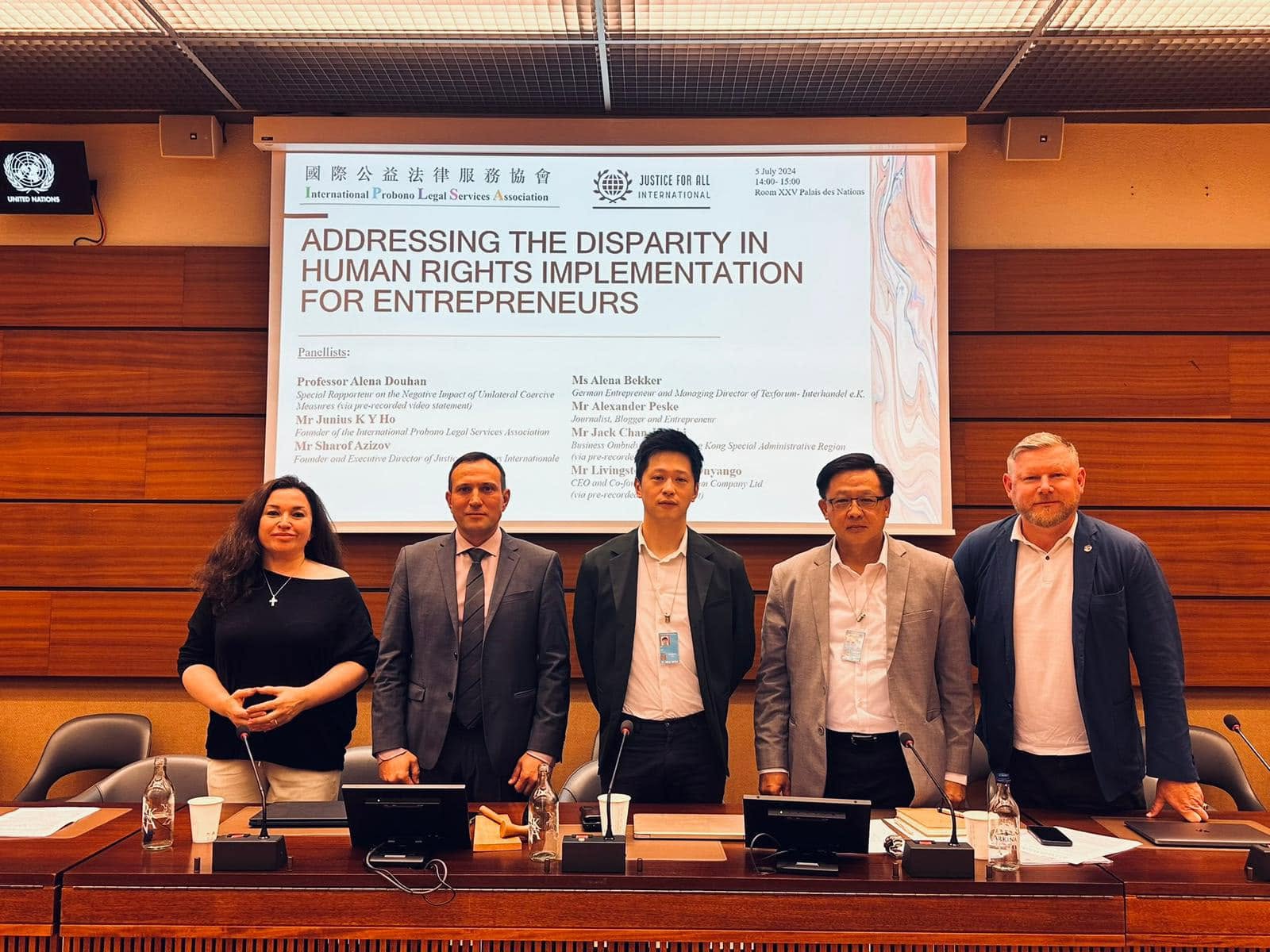
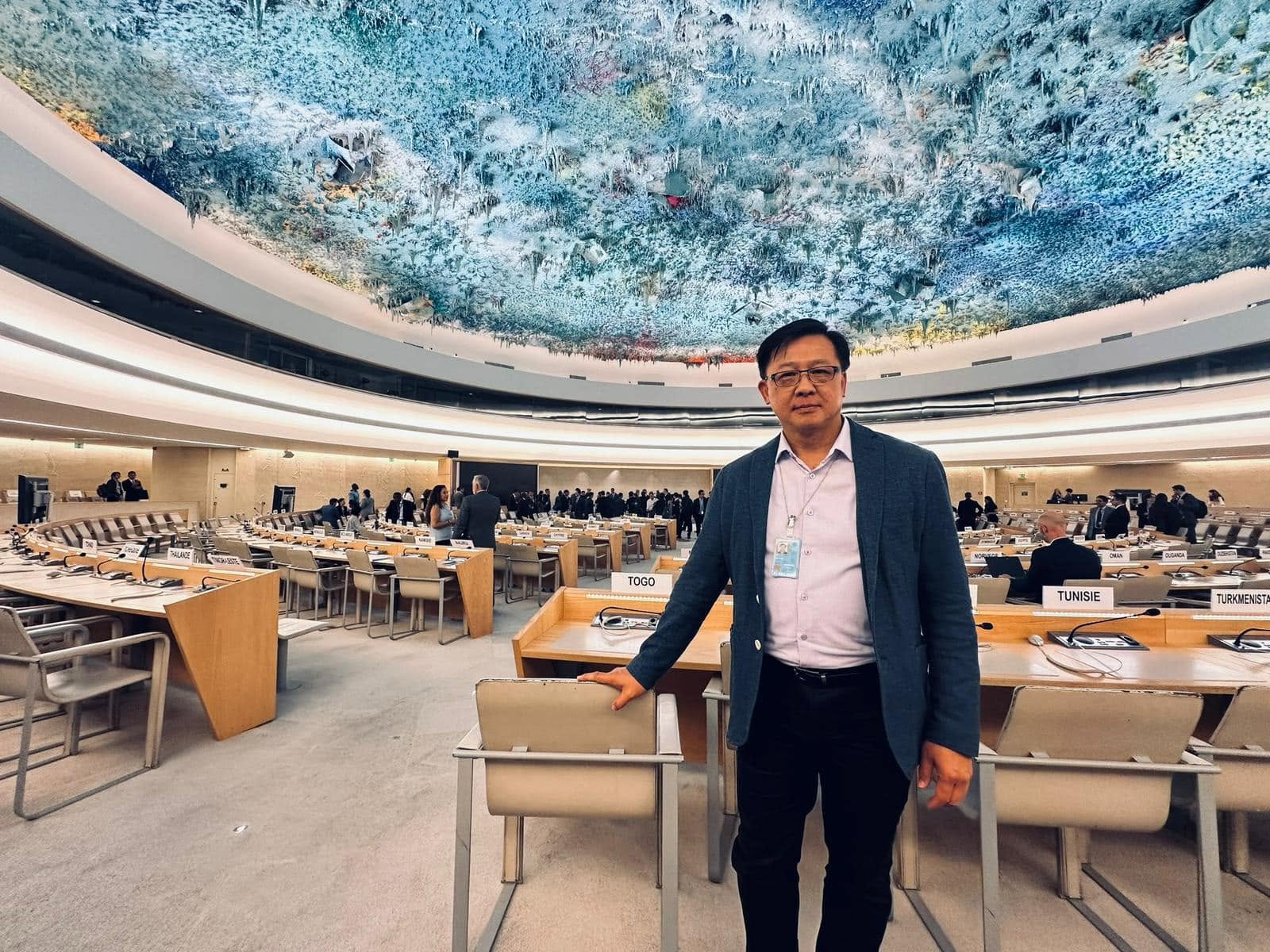
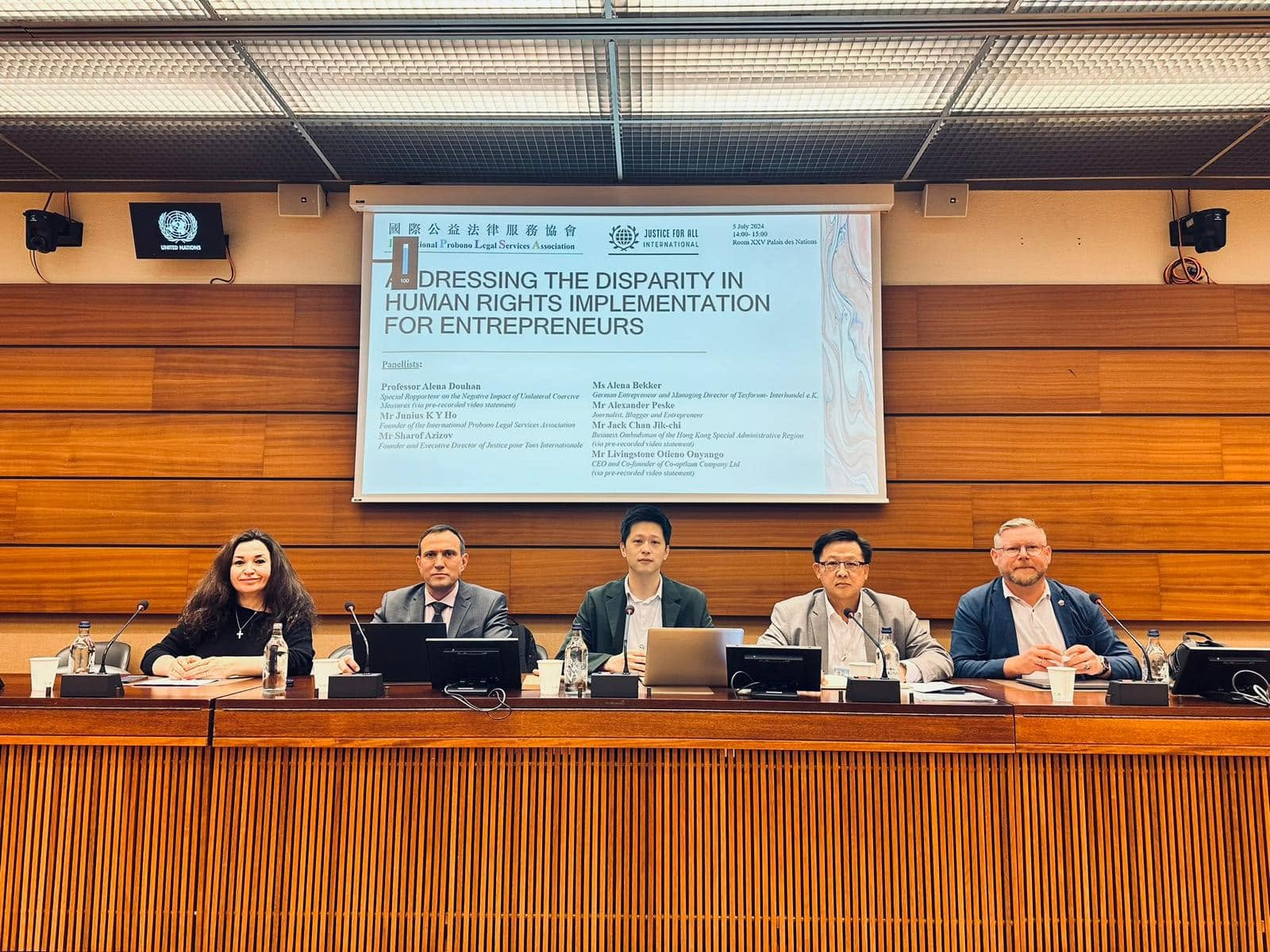
Co-organized by the International Philanthropic Legal Services Association (IPLSA) and International Justice for All, a side event of the 56th Session of the UN Human Rights Council was held on July 5 at the United Nations Headquarters in Geneva. Themed "Human Rights and Entrepreneurs," the event invited experts and business owners to join the panel alongside organizers\' representatives Mr. Junius Ho and Mr. Sharof Azizov. Junius Ho pointed out that sanctions should not be used lightly; otherwise, they would violate the UN Charter\'s objective of encouraging peaceful coexistence among different nations.
The order of speakers was as follows:
Prof. Alena Douhan stated that commercial activities are often hesitant to engage in international trade with sanctioned nations. Every country must safeguard its domestic business continuity and ensure that humanitarian trade, including food and medicine, remains unaffected by any form of unilateral sanctions. Prof. Douhan also called for the removal of all unilateral sanctions that violate international law.
Junius Ho reminded the international community to reflect on the 2019 social unrest in Hong Kong. He stated that it was manipulated by hostile forces, which subsequently triggered a series of unilateral sanctions by the United States against Hong Kong as an unreasonable means to achieve political goals. Under these sanctions, some financial institutions in Hong Kong were forced to relocate, but fortunately, with the strong support of the Central Government, Hong Kong successfully overcame these challenges. Citing Prof. Douhan\'s remarks, Ho emphasized that sanctions should not be applied lightly, as they run counter to the UN Charter\'s mission of promoting peaceful coexistence among nations.
Livingstone Otineo Onyango from Kenya expressed deep concern regarding the future of small and medium-sized enterprises (SMEs) in his country. He noted that protests against the 2024 Finance Bill severely impacted the survival of SMEs, as rioters used the demonstrations to loot and burn down shops. Lacking adequate protection from the government, countless employees, suppliers, consumers, and communities are now facing risks of economic collapse.
Alena Bekker from Germany, whose enterprise operates using timber sourced from Belarus, remarked that the German government arbitrarily interpreted relevant sanctions clauses, leading to unjust prosecutions and penalties against businesses. This resulted in severe financial losses, and she argued that unilateral sanctions clearly infringe upon international law and human rights standards.
Sharof Azizov expressed that the erosion of business rights has consistently been a pressing human rights concern that demands immediate attention. Unilateral sanctions bring severe repercussions, particularly for SMEs. These consequences include the loss of ownership and economic instability, directly undermining innovation and career prospects.
Alexander Peake from Switzerland pointed out that entrepreneurs frequently confront disproportionate legal burdens, a lack of financial backing, and political and economic instability, which directly impede business revitalization. Taking German SMEs as an example, surveys indicate that up to 266,000 enterprises—accounting for 7% of the nation\'s total—are projected to close by the end of 2025, presenting a highly concerning scenario. This pessimistic trend stems from various factors, including excessive regulations, political sanctions, and economic headwinds. Regarding political sanctions, Peake concluded that resolving unequal human rights regulations on businesses requires collective efforts from all stakeholders. Governments must strengthen protective measures for enterprises, ensure a balanced legal framework, and integrate international human rights standards.
The Ombudsman, Jack Chan, congratulated the side event on its successful organization. He emphasized that commitments to quality, fairness, transparency, and public service serve as the bedrock for the sustainable and stable development of any society worldwide. Hong Kong\'s success in overcoming various challenges in recent years serves as a profound testament to this philosophy.